
How are associations applying AI for game-change results?
Thad Lurie of AGU discusses how associations can use AI to build trusted communities, improve data strategy, and drive member engagement through connection
An interview with Thad Lurie CAE, AAiP, CIP, Senior Vice President, Digital and Technology at the American Geophysical Union (AGU), a global community supporting more than half a million advocates and professionals in the Earth and space sciences.
AGU’s Mission and the scale of the challenge
Brian Birch: I'm fascinated by the association you work for. Give me the recap of your mission real quick.
Thad Lurie: So the American Geophysical Union (AGU) is the largest organization of Earth and space scientists on the planet. We have a huge community, primarily academic, primarily research driven, although there are plenty of industry entities and non academic partners. But we work with academics, consortia and people who are doing on-the-ground research. It's a really broad and rich community, estimated somewhere in the neighborhood of half a million people who interact with us in some way or another.
Brian Birch: You recently launched a new tool that helps to connect members, an advanced recommendation engine, using some advanced AI backend… tell me about that.
Thad Lurie: We built the tool based on amplifying the event and connection experience. At AGU we've built some of these AI capabilities to introduce people, mainly those who are doing really similar research, and connect them at our annual event. Last year's AGU conference in (2024) had 31,000 people. It's just huge.
Brian Birch: Holy cow. Yeah.
Thad Lurie: And that's fantastic because it represents the community. It's also a huge obstacle for newcomers. When you come to a show of 30,000 people, how do you find your tribe? Finding the other people that are doing that historically has been really hard. So we decided this was a great AI use case.
The mechanics of privacy and vectorization
Brian Birch: I saw in there that you have a tool that allows them to connect with other people, but you don't track who they connect with, for privacy issues. Tell me about that decision.
Thad Lurie: Well, this has been a really interesting line to walk. People are very privacy sensitive these days. We went back and forth on it. Essentially the matching algorithm allows us to take the entirety of the text of everything that you've done with us and turn that into a digital fingerprint that represents you.
Brian Birch: Is it like a schema, like a JSON thing?
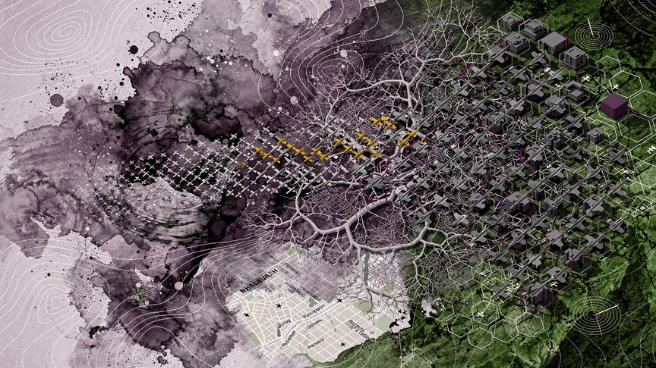
Thad Lurie: It's a process called vectorization. So basically, it represents you as a mathematical equation in multiple dimensions. I can compare your vector to everybody else's vector, literally hundreds of thousands, almost instantaneously. And I can tell your research is most similar to these five other people.
And that's where the privacy became like, okay, do they want to be contacted? Do they want Brian to have their information?
Brian Birch: I see, it's very hard to predict how people will feel about all of that.
Thad Lurie: Right, we don't have an opt in system for that yet. So instead of giving someone your email address, I give them your AGU profile. Then they can click on it, they can see the papers that you publish, the abstracts you submitted, where you work. If in your privacy settings you've said it's okay for them to contact you, they'll be able to. Initially, we thought about actually trying to build an AGU networking app. But we realized, that's LinkedIn. Why would we try to rebuild that?
Building a broader base for the future
Brian Birch: Walk me through the process of data collection you went through to create this data model and populate it with real data.
Thad Lurie: We had a lot of the data already—publishing history and scientific abstracts. In scientific publishing, there's something called an ORCID, which is a universal identifier that all the journals use. We can use their ORCID and go through a couple different API services to pull the text of what they published elsewhere. All we do is add it to their profile in our algorithm so that we know more about them.
Brian Birch: Another node connected to theirs.
Thad Lurie: It adds more depth to the profile. Basically, we're building a really primitive neural network. What I really want to do is put this in the hands of the American Cancer Society, American Medical Association, American Dental Association. Because once you start thinking about what would happen if everybody had the capability of isolating the individuals who are doing stuff that's very much like what you're doing, the speed and accuracy with which we can build professional networks increases exponentially.
Brian Birch: Right! And it's still empowering to the individuals. Was that more an informal decision you all made or a policy?
Thad Lurie: No, we added it as a policy. When we start sending recommendations, we err on the side of letting people control their privacy. We added a link that said, if you want to be excluded from these types of activities, let us know. We've sent hundreds of thousands of emails. We have never had someone come to us, not once, to have their data removed.
Results: the engagement numbers jumped off the page
Brian Birch: You're really helping them navigate this really time-crunched scenario...you're kind of like flipping the ‘Hey newcomers!’ reception concept on its head.
Thad Lurie: It never did work well. And I can tell you objectively, our success measures and our engagement has been insanely high. The open rate of one of those emails was over 90%. The click through rate was 26%.
Brian Birch: That's amazing.
Thad Lurie: In the first quarter of 2024, the user page that it lands on had approximately 1,000 visits. After we launched, in the first quarter of 2025, that user page had over 45,000 visits.
Another thing that associations do well is we build community. Within the community there is trust. If AGU tells you that so and so is doing this publishing, it's because they are. So we're giving you not only suggested connections, but verifiably trusted connections.
What comes next for AI and associations?
Brian Birch: Ok, you’ve built this amazing, intelligent system, what comes next?
Thad Lurie: We can do a lot more. We can take a group of 15 people, do a similarity clustering algorithm, and send them all a notice asking if they would like to join a peer cohort conversation. This work creates some new possibilities and improves quite a few that were already there.
Brian Birch: In terms of broader AI adoption, what do you think is going to be that game-change moment for associations?
Thad Lurie: I want to make sure other organizations understand that it's not a huge price tag, it's not a huge tech buildup; this is absolutely possible. On the other hand, we’ve got to understand how we are using AI internally and what kind of issues we encounter.
Brian Birch: For real, associations are excited but there is a lot of caution.
Thad Lurie: I think associations always see the risk first, but there is also incredible opportunity. We need to be ready to invest. We need to clean up our data. This is data driven in that what happens in your data happens on the screen in front of your users. This is not necessarily a technology thing; this is an organizational thing. I guarantee you, folks in my organization are already thinking about things I've never dreamed of, and that’s the most exciting thing of all!
Related Articles
More from AI & Automation

How are associations applying AI for game-change results?
Thad Lurie of AGU discusses how associations can use AI to build trusted communities, improve data strategy, and drive member engagement through conne...
 pdf
pdf
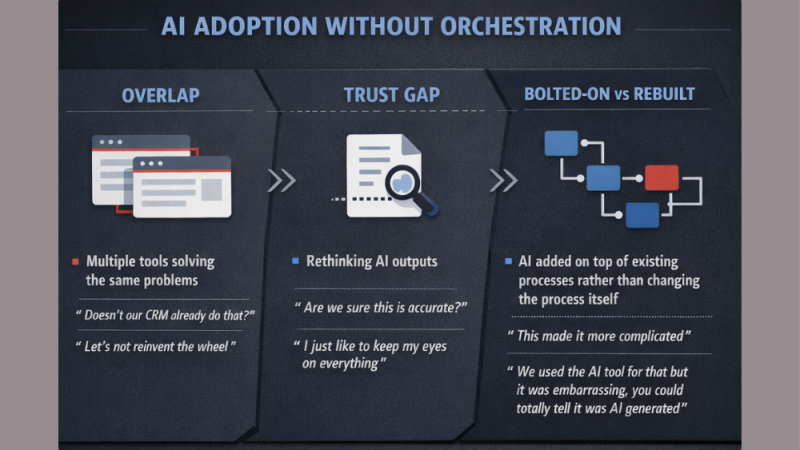
AI adoption without orchestration - infographic
An infographic highlighting risks of AI adoption without orchestration between key functional areas.
 pdf
pdf
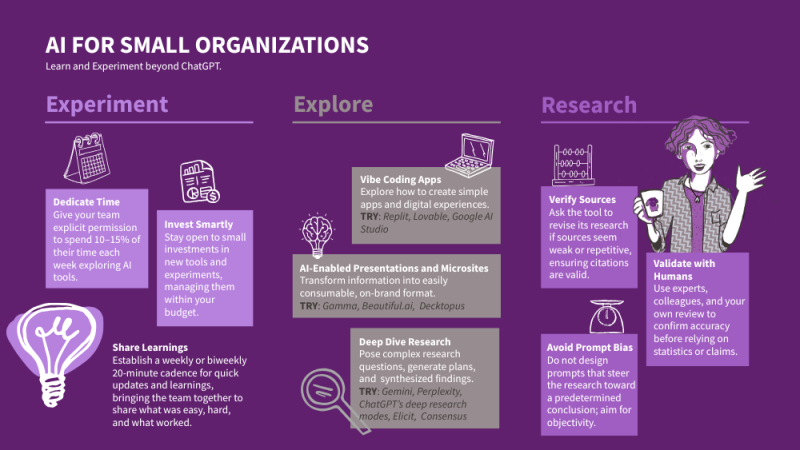
AI for small organizations
An overview of AI adoption for small organizations from harrierbiz.com.
Explore more insights
Discover more articles on marketing, technology, and AI adoption.